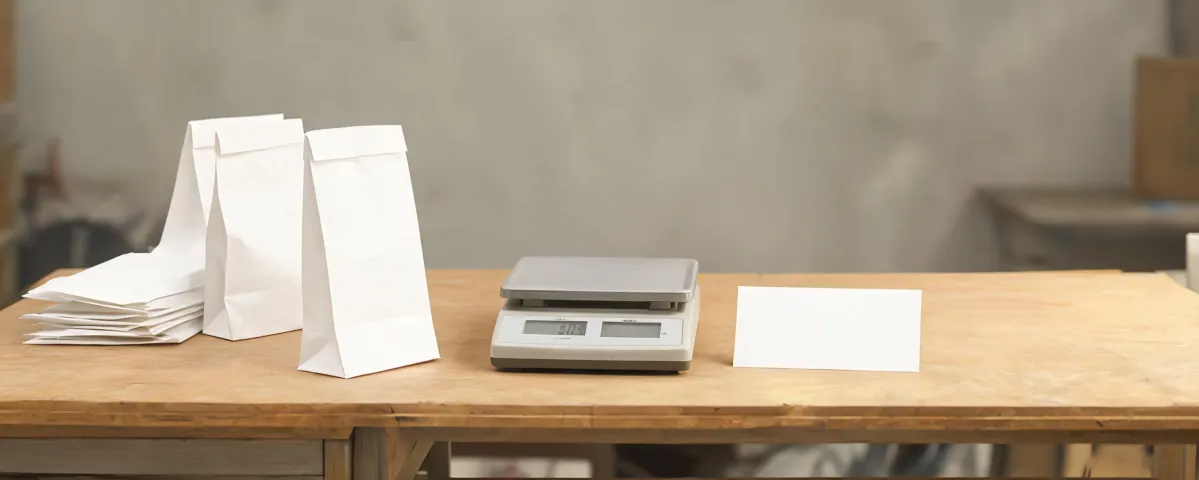
In March 2025, a procurement manager I work with forwarded me three quotes for custom white kraft paper bags. Same specs, she said. Same dimensions, same twisted-paper handles, same 180gsm paper. Three kraft paper bags manufacturers, three prices: $0.38, $0.44, and $0.51 per unit.
She picked the $0.38. Three weeks later, she called me from a warehouse loading dock, holding a pallet of bags that were the wrong shade of white and 6mm short of her product's width.
"They said it was within tolerance," she told me. The reprint cost $2,300. The launch slipped nine days. And that $0.38 quote turned out to be the most expensive of the three.
I've been handling packaging sourcing orders for eight years (since 2017, mostly boutique retail and event production). I've personally made and documented six significant mistakes in that time—roughly $14,000 in wasted budget. That's why our team's pre-check list lives taped inside a desk drawer. The pattern below is the one I see most often, and it's almost never what buyers think it is.
The Question Buyers Ask vs. What They Should Be Asking
Most buyers I work with open with "what's your best price per bag?" It's a fair question. It's also the wrong one.
The question that actually protects a budget is: "What's the all-in cost for 5,000 bags, delivered, with one round of revisions included?"
Those two questions can get answers that differ by 40-60%. Not because suppliers are lying, but because per-unit pricing only captures the part of the transaction that's easy to compare. Everything else—setup, plates, color matching, overruns, freight, the cost of a two-week delay—lives outside the number you're staring at.
Why the Cheapest Quote Is Usually the Most Expensive
Here's the pattern I didn't understand for my first three years in this job: the factory quoting $0.38 isn't necessarily worse at making bags. It's often just competing on a different line item.
Think about how a low quote wins. It wins because the buyer compares unit price. So the supplier prices the unit low and recovers margin somewhere else: a $180 plate fee, a $250 color-matching charge, a 10,000-piece minimum when you needed 4,000, a rush fee when their standard lead time doesn't match your launch date. The $0.51 factory folds those into a higher per-unit number and looks expensive on the spreadsheet.
The assumption most buyers make is that a cheap quote reflects efficiency. In practice, it more often reflects a deliberate pricing structure. The low number is the door. The extras are the room.
I learned this in 2019, on a 3,000-piece order of custom boutique kraft paper bags—matte white, soft-touch, gold foil logo. I picked a supplier that came in $180 cheaper on setup. What I didn't ask: had they run soft-touch white before? They hadn't. The foil didn't adhere cleanly on 400+ bags. Reprint cost: $1,600. The client was polite about it. They didn't reorder.
Then there's the eco-friendly conversation, which has its own trap. In 2022, a client asked us to source custom kraft paper bags for events—a product launch, roughly 2,500 bags. They said "eco-friendly." We ordered standard white kraft and assumed the material spoke for itself. Two weeks later, their marketing team came back needing an FTC-compliant recyclable claim. Per the FTC Green Guides (16 CFR Part 260, revised in 2012), a "recyclable" claim requires that the item actually be recyclable wherever at least 60% of consumers have access to recycling facilities. Our supplier had documented none of that. We spent three weeks chasing certificates, missed the artwork deadline, and air-freighted a partial order to make the event.
That one taught me a specific lesson about custom kraft paper bags for eco friendly brands: "eco-friendly" is a marketing word, not a spec. If a client needs the claim, you need documentation in writing—FSC chain of custody, recyclability evidence, whatever the claim actually requires—before you place the order. Suppliers will usually give you what you ask for. They rarely volunteer what you forgot to ask for.
What the Hidden Costs Actually Add Up To
I started tracking this in 2023. Across 11 orders that year, the quoted unit price averaged $0.41. The actual landed cost averaged $0.58. That's a 41% gap, and it broke down roughly like this:
- Setup, plates, and color matching: 8-14% of unit cost (sometimes quoted separately, sometimes buried under "tooling")
- Overruns and MOQ surplus: 5-11%, depending on whether we could actually use the extras
- Freight variance: 4-9% (white kraft is bulky, and dimensional-weight surprises are common)
- Rework or partial reprints: 0% on good orders, 30-55% on the two that went wrong
That last line is the one that kills budgets. A single reprint on a 5,000-piece order can wipe out the savings from five cheap orders.
One more example, because it's the one that finally broke me. In early 2024, we ordered 4,000 bags for a trade show client. The $0.40 unit price was fine. What we missed: the supplier's standard carton packs 250 bags, not 200. Our fulfillment center's receiving system was set up for 200-count cartons. Reconfiguring the intake process cost $340 and half a day of warehouse labor. Nobody on either side of the transaction thought about carton configuration, because it isn't on the quote sheet.
I'm not going to claim any of this is statistically rigorous—11 orders is a small sample—but the pattern showed up consistently enough that I stopped trusting unit price as a comparison tool. In Q1 2024, I finally built the checklist I should've built in 2018.
The TCO Checklist I Use Now
Before comparing any two quotes for white kraft paper bags, I calculate total cost of ownership on a single line:
TCO = unit price + setup/plate fees + expected revision rounds + overrun exposure + freight + delay risk + rework probability
The last two are estimates, not facts. I usually pencil in delay risk at 3-5% of order value and rework probability at 10% unless the supplier has a documented track record with that exact spec. There's a grain of salt involved. The point isn't precision—it's honesty about what the quote sheet leaves out.
Three questions do most of the work:
- "What's included in this unit price, and what gets billed separately?" Ask for it in writing. Verbal "all-in" promises have a way of evaporating after the PO is signed.
- "What's the MOQ, and what happens if I order 20% below it?" Some manufacturers flex; some don't. The flex usually costs more than you'd expect.
- "Can you show documented tolerances for white and for color matching?" "White" isn't a color, it's a range. Get the range in writing before artwork gets approved.
For eco-friendly claims, I add a fourth: "Which specific certification or documentation supports this claim?" If the answer is vague, the claim is vague, and the FTC has been clear about what happens to vague environmental claims.
That's the checklist our team runs at White Kraft Paper Bags Sourcing before any custom order leaves the desk. I'm not going to pretend this makes procurement exciting. But since I started using it in early 2024, we've caught 47 potential issues before they became purchase orders—wrong tolerances, missing certifications, MOQ traps that would've tied up cash for six months.
The $0.38 quote isn't the problem. Believing it is.